博客

  • Hand Washing vs Commercial Dishwasher: Labor Costs, Water Savings, and Payback Timeline

    Hand Washing vs Commercial Dishwasher: Labor Costs, Water Savings, and Payback Timeline

    For independent restaurants, school canteens, and corporate catering facilities, dishwashing is frequently viewed through a narrow lens: why spend thousands of dollars on a commercial warewashing machine when a three-compartment sink and manual labor already get the job done?

    The reality inside a working dishroom tells a different story. Manual dishwashing is consistently one of the highest operating expenses in food service, driven by three relentless drains: utility payroll, uncontrolled hot water waste, and tableware breakage. Upgrading from manual sinks to an automated commercial dishwasher is rarely an equipment luxury—it is an operational calculation designed to lower the cost per clean plate.

    This guide compares manual three-compartment sink washing with automated commercial dishwashers using verified operational data, utility metrics, and a practical payback model.

    1. The Three Hidden Financial Drains of Manual Sinks

    A three-compartment sink (Wash, Rinse, Sanitize) appears inexpensive because its primary cost is invisible on equipment invoices. However, monthly operating statements reveal where the money actually goes.

    A. Labor Payroll and Staff Turnover

    Manual washing requires constant human handling. A restaurant serving 250 to 400 meals per day typically requires two dedicated kitchen staff members during peak lunch and dinner hours just to keep up with soiled pots, pans, and tableware. In high-volume operations, utility workers spend 5 to 7 hours per shift standing at sinks, scrubbing, rinsing, and drying.

    Dishwashing positions also have the highest turnover rate in commercial kitchens, frequently exceeding 70% annually. Constantly recruiting, onboarding, and training new dishroom staff adds thousands of dollars in administrative overhead and leads to kitchen bottlenecks during busy service periods.

    B. Uncontrolled Water and Heating Consumption

    In a manual setup, kitchen staff frequently leave pre-rinse sprayers and fill faucets running continuously. A standard commercial sink faucet flows at 2.5 to 3.5 gallons per minute (9.5 to 13.2 liters per minute). Over a four-hour peak service, manual washing can easily consume 600 to 1,200 liters of hot water. Heating this large volume of water significantly increases commercial gas and electric bills every billing cycle.

    C. Tableware and Glassware Breakage

    Handling wet, soapy porcelain plates, ceramic bowls, and glassware by hand leads to frequent slips and drops. Commercial restaurants report an average monthly tableware breakage rate of 2% to 4%. For a restaurant with $4,000 in active tabletop inventory, replacing chipped plates and broken glassware costs $80 to $160 per month ($1,000 to $2,000 per year) in avoidable inventory loss.

    2. How Commercial Warewashers Redefine Dishroom Economics

    Commercial dishwashers replace continuous manual handling with consistent, automated mechanical cycles. Instead of human workers scrubbing each dish individually, the machine uses pressurized wash arms, high-temperature sanitizing rinse, and reusable wash water.

    Water Recirculation Engineering

    Modern commercial dishwashers do not drain their entire water volume after every cycle. The main wash tank keeps filtered wash water at 55°C to 65°C across multiple wash runs. Fresh water is only introduced during the final rinse cycle—strictly metered at 2.2 liters per 500x500mm rack on standard Oberon pass-through machines. This reduces total daily water consumption by up to 65% to 75% compared to open sink basins.

    Thermal Sanitization Without Chemical Odor

    Health codes require dishes to reach specific sanitization standards to prevent cross-contamination and bacterial growth. Human hands cannot tolerate water temperatures above 45°C without scalding, forcing manual sinks to rely on chemical chlorine sanitizers that can leave chemical residues, persistent odors, and skin irritation. A high-temperature commercial dishwasher rinses at 82°C to 85°C (180°F to 185°F), achieving thermal sanitization in 60 to 90 seconds while dishes air-dry rapidly from flash evaporation.

    Predictable Labor Throughput

    Instead of washing dishes one by one, a single operator scrapes food waste, loads dishes into standard 500x500mm racks, and slides them into the machine:

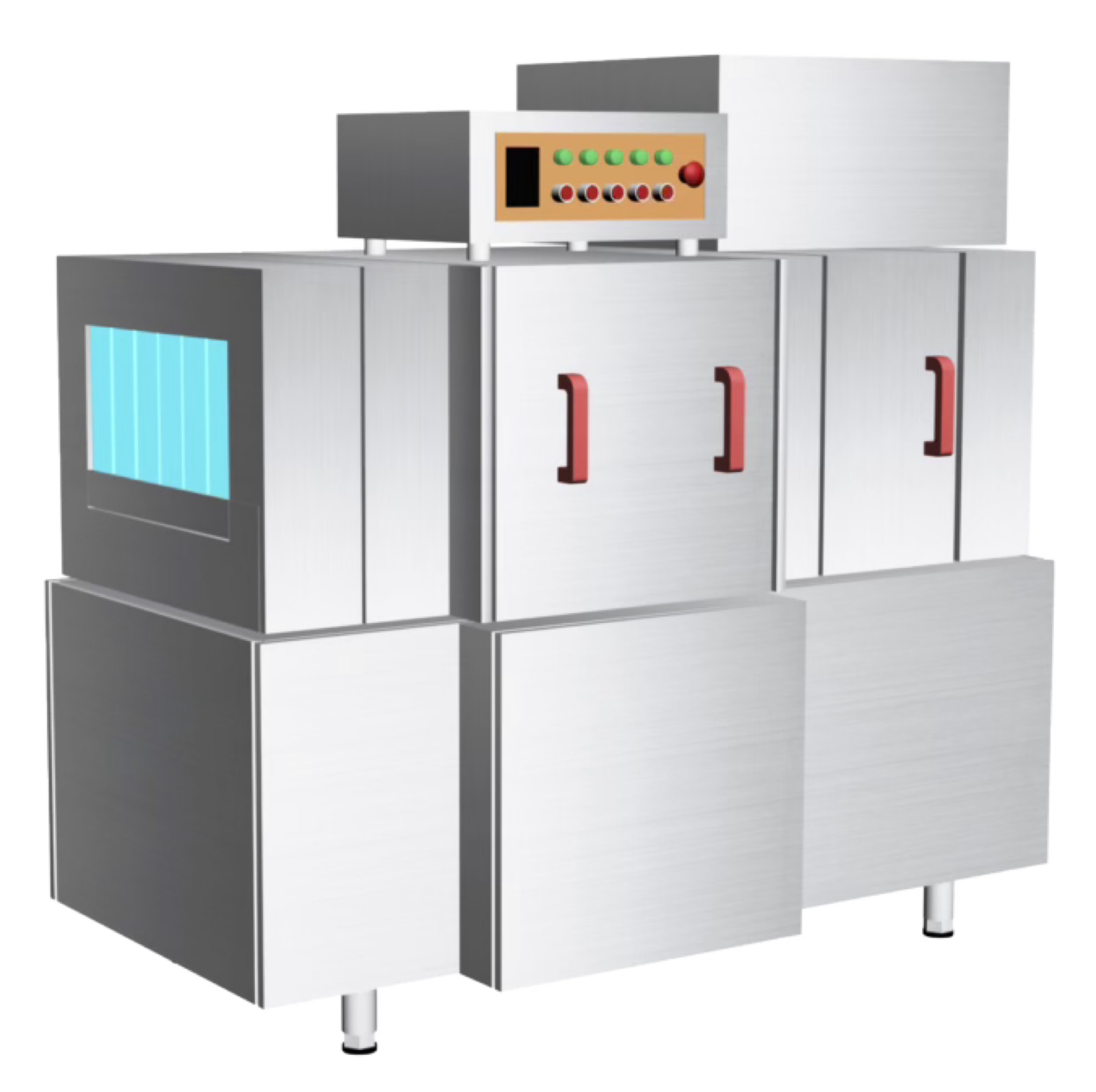
    • Hood Type (Pass-Through) Machine: Processes 50 to 70 racks (900 to 1,260 plates) per hour with one operator.
    • Rack Conveyor Dishwasher: Processes 120 to 200 racks (2,100 to 3,600 plates) per hour with two operators (one loading, one unloading).

    Dishroom labor hours drop immediately by 50% to 70%, allowing cross-trained kitchen staff to assist in food prep or dining room service.

    3. Side-by-Side Operational Comparison

    The table below outlines the core operational differences between manual sink washing, a hood-type commercial dishwasher, and a high-volume rack conveyor system.

    Operational Parameter Manual 3-Sink Station Hood Type Dishwasher Rack Conveyor Line
    Staff Required (Peak) 2 to 3 workers 1 worker 1 to 2 workers
    Plates Cleaned Per Hour 200 to 350 plates 900 to 1,260 plates 2,100 to 3,600 plates
    Cycle Duration Continuous scrubbing 60 to 90 seconds Continuous conveyor belt
    Water Use Per 100 Plates 150 to 250 Liters 12 to 18 Liters 8 to 14 Liters
    Sanitizing Method Chemical chlorine soak Thermal rinse (82°C–85°C) Thermal rinse (82°C–85°C)
    Breakage Rate 2.0% – 4.0% per month <0.3% per month <0.2% per month

    4. The 12-Month Financial Model: A Realistic Payback Calculation

    To understand the return on investment (ROI), examine a standard mid-size restaurant or corporate canteen serving 300 meals per day (approximately 1,200 total tableware items, glasses, and utensils daily).

    Annual Baseline: Manual 3-Sink Washing

    • Labor Cost: 2 dedicated utility workers at $2,000/month each = $48,000 per year.
    • Water and Heating Utility Cost: 800 liters/day at local commercial rates = approximately $2,400 per year.
    • Tableware Replacement (Breakage): 3% monthly inventory loss on $3,500 inventory = $1,260 per year.
    • Chemical Consumables (Manual Detergent & Sanitizer): $80/month = $960 per year.
    • Total Manual Annual Cost: $52,620

    Annual Operating Cost: Hood Type Commercial Dishwasher

    • Labor Cost: 1 part-time/cross-trained worker handling washing for 3 hours/day ($1,000/month) = $12,000 per year.
    • Water and Electricity Cost: 2.2L per rack across 65 racks/day = 143L/day. Annual utility estimate = $950 per year.
    • Tableware Replacement: Racks protect ceramics from impact; annual breakage drops to <$250 per year.
    • Commercial Detergent and Rinse Aid: High-efficiency automated dosing = $1,100 per year.
    • Equipment Investment (One-Time Factory Direct): Commercial hood type machine, entry/exit tables, and racks = approximately $5,500.
    • Total Machine First-Year Cost: $19,800 (including equipment purchase)

    The Bottom Line: Payback in 5 to 7 Months

    In Year 1, moving from manual washing to an automated hood type machine saves $32,820 in net operating expenses, completely paying off the initial equipment cost within 5 to 7 months of operation. In Year 2 and beyond, after the equipment is amortized, the annual recurring savings exceed $38,000 every single year.

    5. When Should a Facility Transition to a Machine?

    Every commercial kitchen reaches a tipping point where manual washing stops being economical. Upgrade planning should begin when any of the following operational signals occur:

    1. Daily volume exceeds 100 to 150 meals: At this volume, manual scrubbing inevitably creates dining room turnaround delays or forces cooks to stop prep work to wash pots.
    2. High staff turnover in the dish pit: If the kitchen struggles to retain utility staff or suffers from constant absenteeism on weekends, automated equipment removes dependency on hard-to-hire labor.
    3. Health inspection warnings on sanitization logs: Health inspectors require verified sanitizing logs. A commercial machine with temperature gauges provides indisputable temperature compliance proof on every wash run.
    4. Space constraints in tight kitchens: Compact pass-through dishwashers occupy as little as 0.65 square meters of floor space, fitting straight or corner dishroom configurations while replacing bulky three-sink lines.

    6. Frequently Asked Questions

    Does a commercial dishwasher require dishes to be pre-rinsed?

    Yes. Plates should be scraped of large food solids and given a quick 3-second overhead spray before racking. Pre-scrapping keeps the main wash tank clean across dozens of cycles, ensuring optimal cleaning results without draining the tank.

    What utility connections are required for a pass-through machine?

    A standard commercial hood type dishwasher typically requires a 380V three-phase electrical supply (custom single-phase 220V available upon request), a 3/4-inch water inlet line with 2 to 4 bar dynamic water pressure, and a gravity drain connection.

    How long does a commercial stainless steel dishwasher last?

    With routine daily cleaning of scrap filters and periodic descaling, a commercial-grade food-safe SUS 304 stainless steel dishwasher typically delivers an operational service life of 8 to 12 years in high-volume hospitality environments.

  • Hood Type Dishwasher: The Pass Through Machine Restaurants Step Up To

    Hood Type Dishwasher: The Pass Through Machine Restaurants Step Up To

    The hood type dishwasher — also sold as a pass through dishwasher — is the machine most restaurants and hotel kitchens settle on after outgrowing an undercounter unit. It sits under a condensate hood, takes standard 500×500 mm racks, and a single operator can push 40 to 60 racks through per hour. This guide explains how it works, what it costs to run, and how to compare models before requesting quotes.

    How a hood type dishwasher works

    An operator rolls a loaded rack into the machine, pulls the hood down, and the cycle runs automatically: wash, then a hot final rinse. The hood lifts, the rack rolls out clean, and the next rack rolls in. Wash and rinse tanks sit below the deck; the condensate hood above captures the steam a 60–80°C wash releases.

    The pass through layout is the same machine from the other direction — racks enter on one side of the hood and exit on the other, passing straight through. Choose the direction that matches your dishroom flow: dirty drop-off on one wall, clean staging on the other.

    Hood type vs undercounter: when to step up

    Undercounter machines tuck under a worktop and suit bars and cafes up to roughly 30 racks per hour. Three signals say it is time to move to a hood type machine:

    • Staff queue at the undercounter between cycles during service.
    • Your site passes 40 racks in any single hour, even occasionally.
    • Pans and trays need their own washing window because the undercounter cannot hold them.

    Above 60 racks per hour sustained, compare rack conveyor dishwashers instead — the step after hood type.

    Running costs: water, power, and the hood

    A hood type machine uses roughly 2 to 3 liters of water per rack. High-temp models draw a 180°F final rinse, which requires a booster heater and usually a condensate hood for steam extraction; low-temp chemical-sanitizing models skip the booster and often the hood, trading hot water for sanitizer chemicals.

    Compare candidates on three numbers: water per rack, tank heating power (recovery speed between racks), and connected load. Our cost guide shows how those numbers translate into monthly running cost, and the water temperature guide covers the sanitizing requirements behind them.

    Installation checklist before you order

    • Height under the hood: confirm the open hood clears your ceiling, extraction ducting, and any shelving.
    • Table height match: entry and exit tables should align with the machine deck so racks slide, not lift.
    • Drainage: a floor drain at the machine, sized for dump-and-refill of both tanks.
    • Power or steam: confirm supply matches the machine’s heating configuration before ordering.
    • Rack standard: 500×500 mm racks across the site keep baskets, peg racks, and flatware racks interchangeable.

    Frequently asked questions

    How many racks per hour does a hood type dishwasher wash?

    Most wash 40 to 60 racks per hour, depending on cycle length. A 60-second cycle with fast hood movement sustains about 60; longer cycles for heavy soil drop the number to around 40.

    What does a hood type dishwasher cost?

    Hood type machines typically run $5,000 to $15,000 installed, moving with chamber height, tank power, and heat recovery options. Oberon quotes against your rack volumes and utility supply — see the 2027 cost guide for the full budgeting frame.

    Pass through and hood type — the same machine?

    Yes. The terms describe the same hood-lift machine used in different flow directions: hood type loads front-to-back under the hood, pass through loads one side and unloads the other. Specifications and racks are identical.

    Related reading

    Sizing a hood type machine for your kitchen? Send Oberon your peak rack counts — application engineers will match a model and layout to your dishroom.

  • Racks Per Hour in Practice: Photos and Numbers from Three Oberon Installations

    Racks Per Hour in Practice: Photos and Numbers from Three Oberon Installations

    Racks per hour is the number every buyer asks about, and the number most quote sheets hide behind footnotes. This case study shows what that number looks like on real floors — a school canteen dishroom, a stainless central kitchen, and a restaurant wash station — using photos from recent Oberon installations.

    The school canteen line: 4,000 trays through one meal window

    Canvas for thought: a school canteen that serves lunch to 2,000 students in 45 minutes collects roughly 4,000 trays, bowls, and cutlery baskets in that window. Hand washing at 6 staff moved about 90 racks in the same period — and the queue outside the dishroom kept growing.

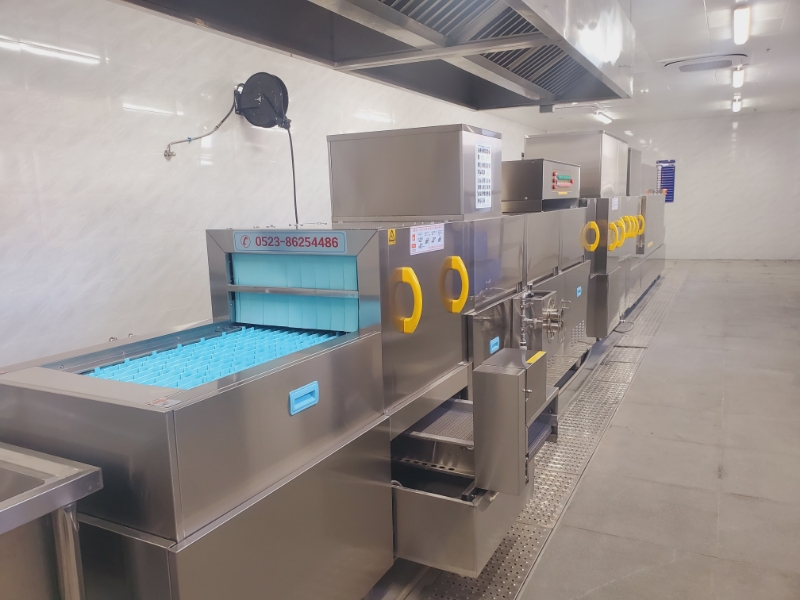
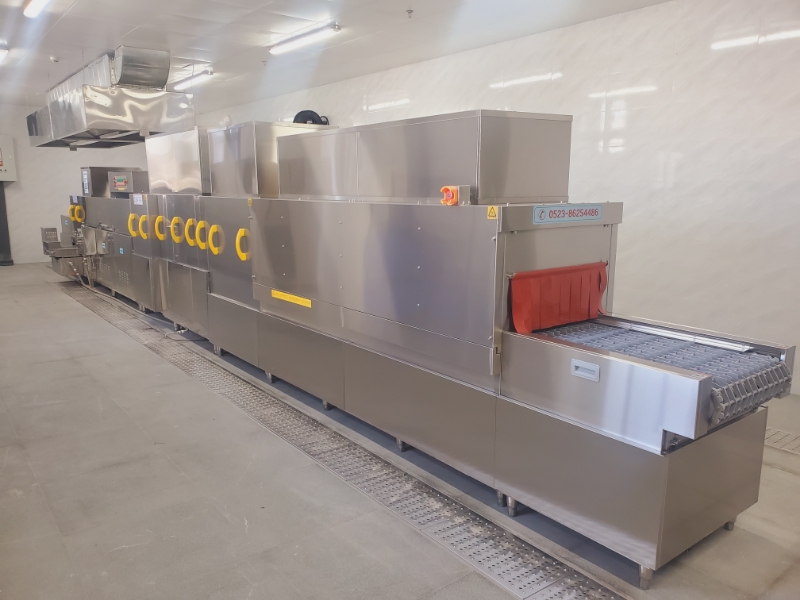
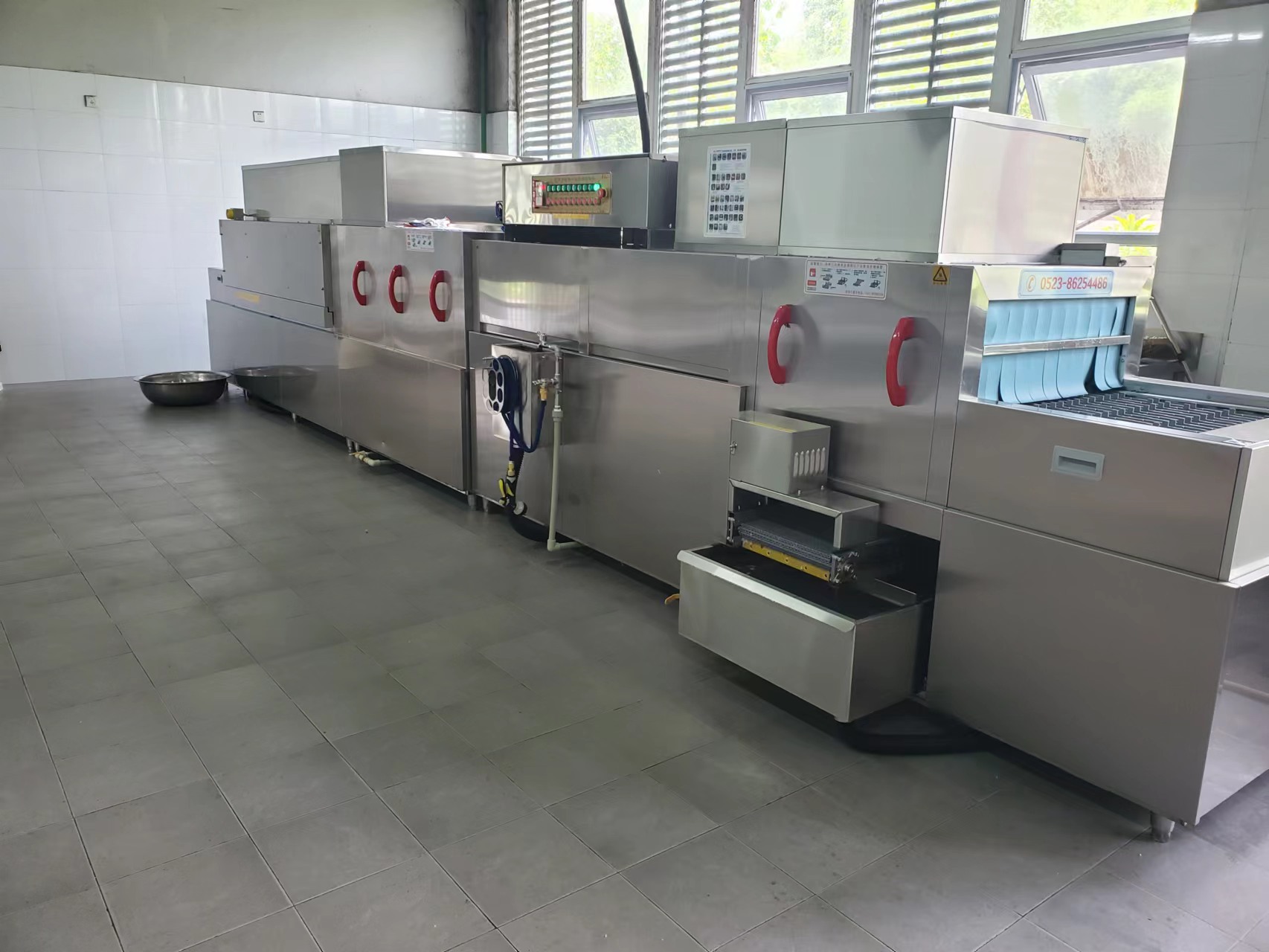
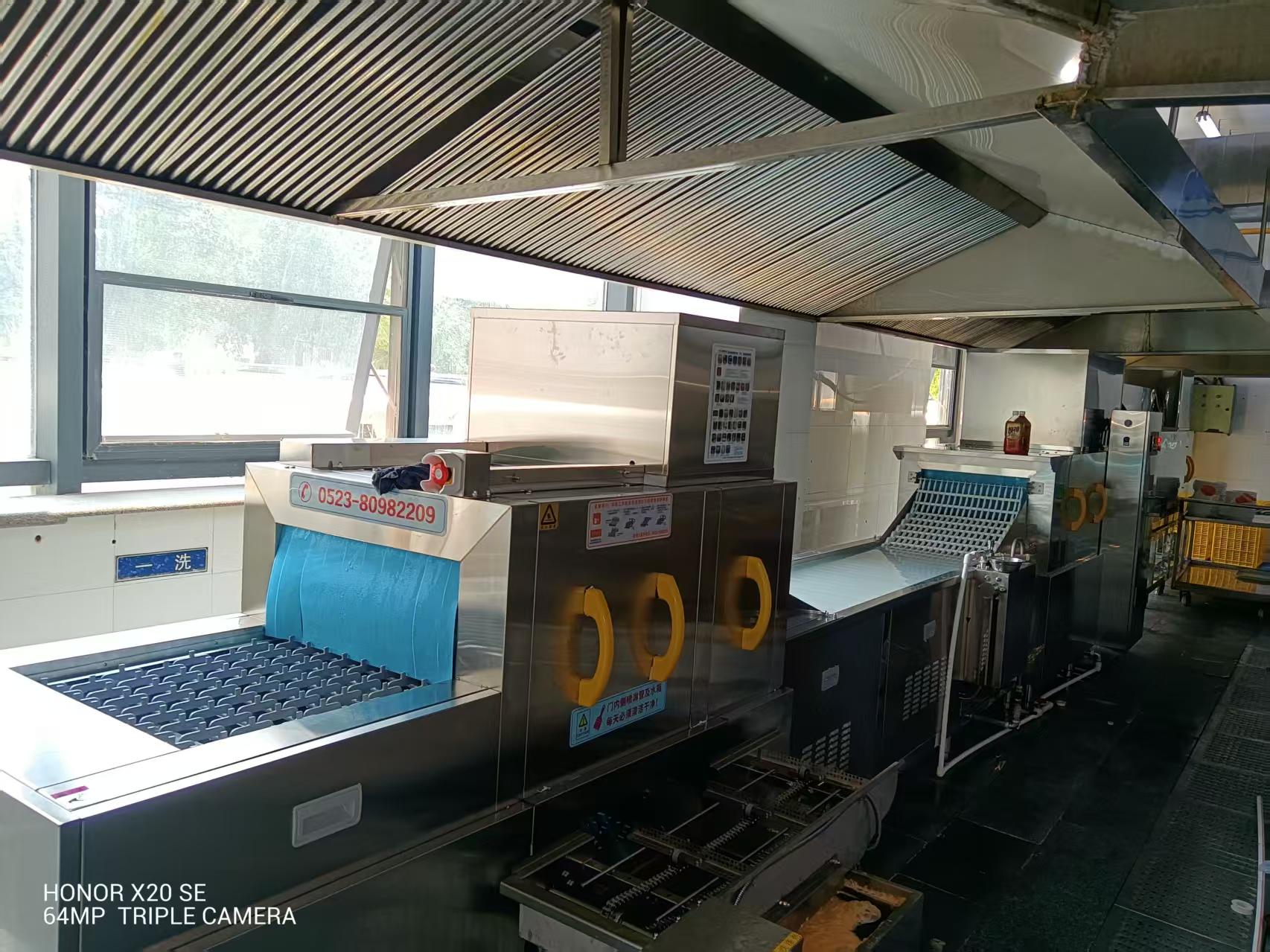
    The installed answer was a rack conveyor line: an entry table with pre-scraping basin, a single-tank rack conveyor dishwasher, and a clean-side exit table. Blue curtain strips at the entry and exit keep steam and splash inside the machine. On the floor, the line runs 60 to 90 racks per hour with 2 staff — one feeding, one collecting.

    What changed in numbers the kitchen manager shared with us:

    • Tray turnaround from drop-off to stack-ready: under 4 minutes
    • Dishroom staff at peak: from 6 to 2
    • Water per rack: from roughly 4 liters (hand flow) to 2.2 liters

    Central kitchen: two crate lines running side by side

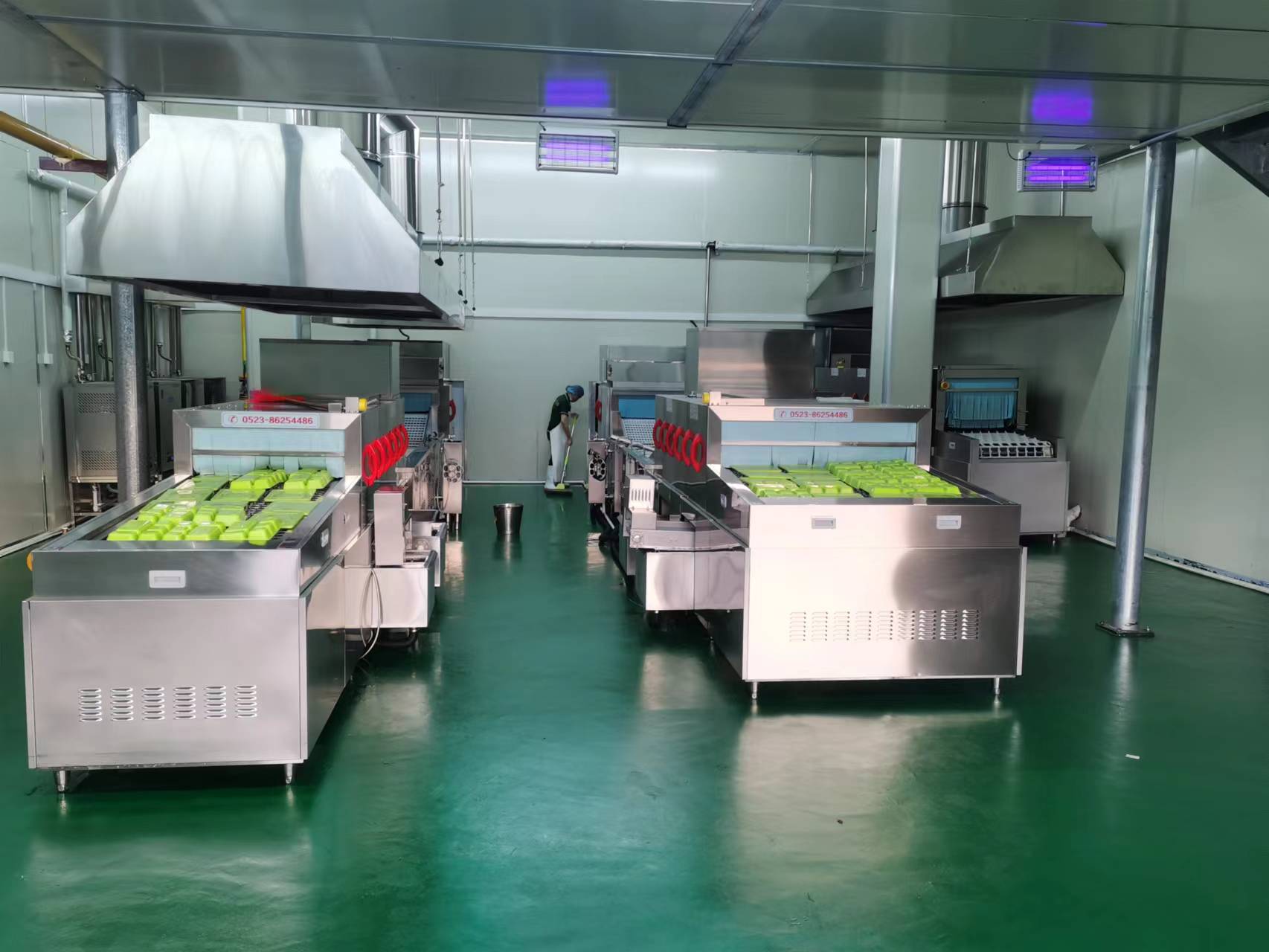
    A central kitchen producing 30,000 meals a day washes crates, not plates. The floor photo below shows twin crate washing lines, each with an upturn section that empties crates before washing — liquid waste drains, solids collect in the detashing drawer, and the washer handles the empty crates at higher belt speed.

    Green crates enter soiled and leave dry enough to stack immediately. The two lines run on alternating shifts during harvest peaks; between runs, the open layout gives one worker full visual coverage of both machines.

    Restaurant stations: when a full line is more than the room needs

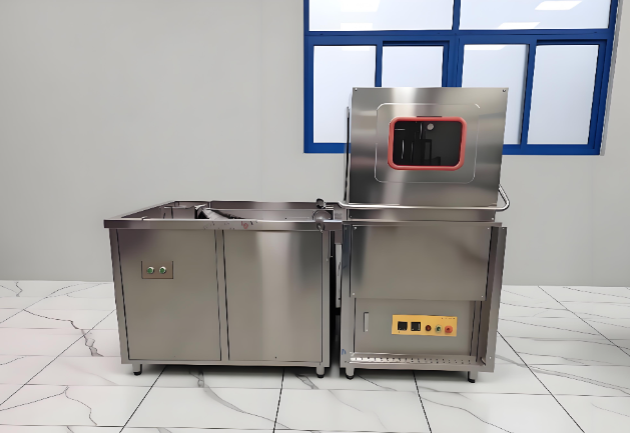
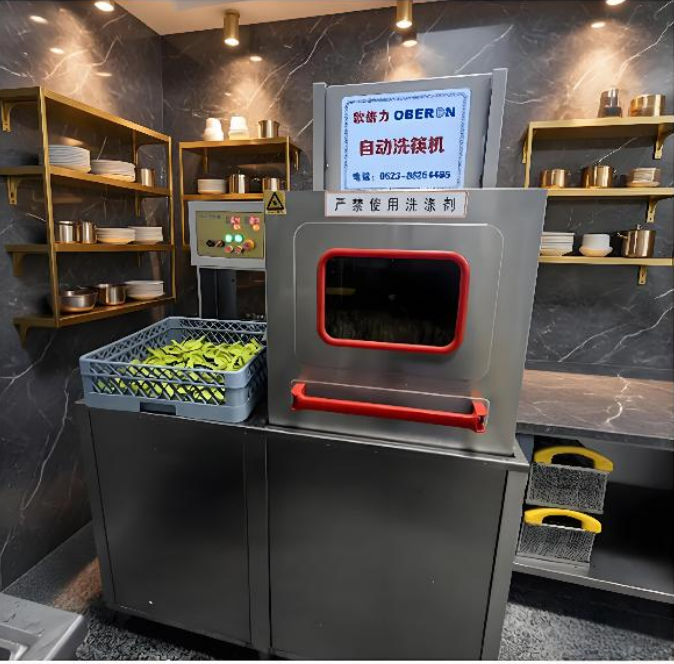
    A restaurant wash station does not always need meters of conveyor. Two undercounter installations from this batch show the compact end of the range: a soiled-side table with scrap basin feeding a hood-type machine, and a stand-alone undercounter unit placed beside a service counter. Both run standard 500×500 mm racks, which keeps the per-rack math simple when comparing with larger lines.

    More from the same installations

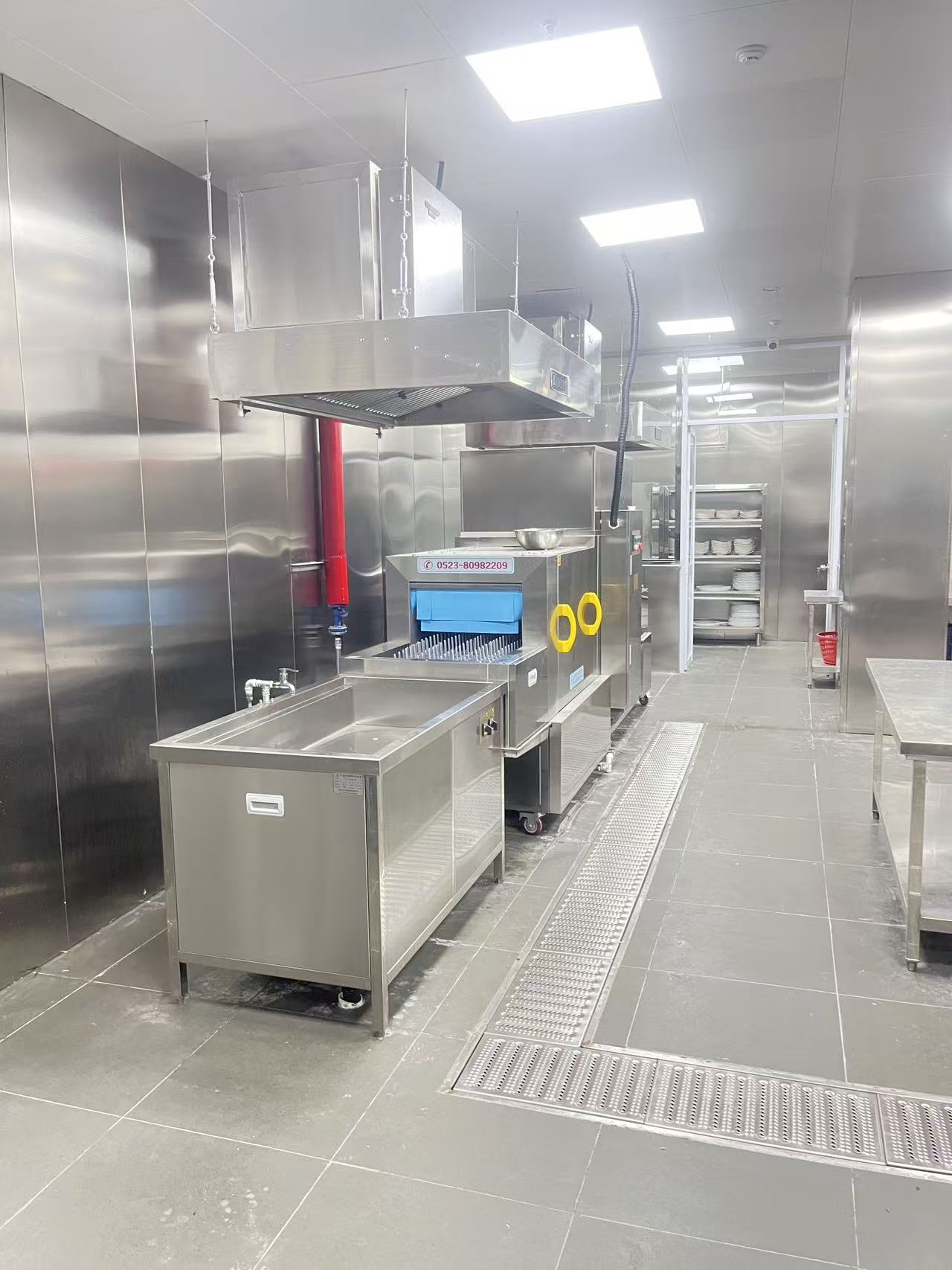
    Stainless kitchens behave differently before and after the line arrives — the photos below show hood-type and flight type installations at handover, with drainage trenches and condensate hoods already in place.

    What these floors have in common

    Three decisions show up in every smooth installation, regardless of machine size:

    • Layout before machine. Soiled drop-off, wash, clean staging in a straight line — the photos all show one-direction flow, no cross-traffic.
    • Floor drainage sized for the worst hour. Trench drains along the whole line, not a single point drain.
    • Rack standard from day one. 500×500 mm racks across the site keep every machine interchangeable and the per-rack cost comparable.

    How to read racks per hour on a quote sheet

    When two machines both claim “high capacity”, check three rows of the specification:

    • Rated racks per hour — and at what soil level the rating was tested.
    • Tank heating power — recovery speed between racks decides whether the rated number survives your peak.
    • Water per rack — 2 L and 4 L look similar on paper and diverge into a second utility bill over a school year.

    Oberon’s own ranges are published openly: rack conveyor lines, flight type systems, and undercounter machines each list capacity, power, and water figures on the product page.

    Planning a canteen or central kitchen line?

    Send us your meal count, peak window, and floor plan — Oberon application engineers will return a layout drawing with a racks-per-hour calculation for your specific tray mix, drawn from installations like the ones above.

    Related reading

  • Crate Washer Buying Guide: Types, Specifications, and Price Factors

    Crate Washer Buying Guide: Types, Specifications, and Price Factors

    Buying a crate washer is a throughput-and-hygiene decision: the machine has to strip labels, grease, and organic residue from plastic crates at your daily volume, then return them stack-ready. This guide explains the types, the specifications that actually matter, and the price factors — so you can compare quotes from any crate washer manufacturer on facts.

    Crate washer types: batch vs continuous

    Batch (cabinet) crate washers wash one load at a time. They suit regional distributors and food processors washing up to a few hundred crates per day, and they tolerate mixed crate sizes in the same chamber.

    Continuous (tunnel) crate washing machines move crates through pre-wash, main wash, rinse, and drying zones on a conveyor. They are the choice for central kitchens and distribution hubs washing 400–800+ crates per hour, every day, with consistent soil levels.

    Oberon builds both configurations — the Oberon crate washing system is rated for 400–800 crates per hour with 5–9 kW power, in custom chamber sizes.

    Specifications that actually matter

    • Crates per hour at your soil level. Rated capacity is measured on lightly soiled crates. Ask each supplier for tested throughput on your soil type — dried sauce and label adhesive wash very differently from dust.
    • Chamber and guide range. If you wash EURO crates, poultry bins, bakery trays, and totes in one machine, confirm the guide rails and spray bar adjustment cover your full item list.
    • Wash and rinse stages. Heavy soil needs pre-wash + main wash + rinse + blow-off. Skipping stages to save cost shows up as re-wash labor.
    • Water consumption per crate. Tank filtration and cascade reuse cut water and detergent costs per crate — the number that compounds over years.
    • Drying performance. Crates that leave wet grow mold in stacks. Confirm heated blow-off or drying zone, not just drip time.

    Price factors: what moves a crate washer quote

    Crate washer price scales with four decisions: hourly capacity, chamber size (your largest item), automation level (manual loading vs powered infeed and stacking), and utilities (electric vs steam heating, water treatment). Because quotes vary widely with configuration, ask every supplier to price against the same written specification — then compare cost per washed crate over five years, not the purchase price alone.

    For a broader budget frame, see our commercial dishwasher cost guide — the same total-cost-of-ownership logic applies to crate washing machines.

    HACCP and hygiene documentation

    Crates contact food directly, so wash performance belongs in your food safety plan. Confirm the machine holds documented wash temperatures, provides readable gauges, and supports detergent dosing control — the three things a HACCP audit will ask to see. More on this in our HACCP compliance guide.

    Frequently asked questions

    What capacity crate washer do I need?

    Size by peak day: count crates returned on your heaviest route day and divide by planned operating hours. A 400 crates/hour machine covers roughly 3,000–4,000 crates in an 8-hour shift with loading time.

    Can one machine wash different crate sizes?

    Yes, if the chamber and guide rails are specified for your full item list upfront. Mixed-size washing trades some peak throughput for flexibility — worth it for distributors with varied product lines.

    How much does an industrial crate washing machine cost?

    Batch machines start below tunnel systems; continuous lines scale with width, stages, and automation. Because configuration drives price, request quotes against a written spec — Oberon provides itemized quotations with utility schedules.

    Do crate washers need hot water?

    Hot main wash (55–65°C) improves grease and label removal; the rinse can be cold with heated blow-off. Electric or steam heating are both available on Oberon machines.

    Related reading

    Ready to size your line? Send Oberon your crate dimensions, soil type, and daily volume — you will receive an itemized quotation with utility schedules from an application engineer.

  • High-Temp vs Low-Temp Commercial Dishwashers: 180°F vs 50–100 ppm

    High-Temp vs Low-Temp Commercial Dishwashers: 180°F vs 50–100 ppm

    Every commercial dishwasher sanitizes one of two ways: a scalding hot final rinse, or a chemical bath at lower temperature. Manufacturers call them high-temp and low-temp machines, and the choice between them shapes your utility bills, ventilation, chemical purchasing, and HACCP records. Here is how they actually compare.

    Updated September 2026: sanitizer contact-time conventions added — chlorine sanitizing at 50–100 ppm with verified contact time remains the standard low-temp path, and 180°F manifold rinse the high-temp path. Full audit documentation guidance is in our HACCP compliance guide.

    How the two sanitizing methods work

    A high-temp commercial dishwasher sanitizes with water heat alone. The final rinse reaches about 82°C/180°F at the manifold for stationary rack and single-tank machines — 71–82°C/160–180°F on conveyor systems — hot enough to kill pathogens on contact and flash-dry items without towels.

    A low-temp commercial dishwasher washes at 49–60°C/120–140°F and sanitizes chemically, usually with chlorine at 50–100 ppm. The machine doses the sanitizer automatically in the final rinse; items then air-dry.

    Energy and utilities: the biggest cost difference

    High-temp machines need booster heaters or steam to hold 180°F rinse water, which draws serious power — and puts steam and moisture into the room, so a condensate hood and good ventilation matter. Low-temp machines avoid the booster heater entirely, cutting energy draw dramatically and often skipping the hood.

    The trade: low-temp machines consume sanitizer chemicals every cycle, and chlorine requires cool storage, dosing checks, and regular test strips. Over five years the chemical bill is real; over the same period the high-temp energy bill is also real. Compare both against your local power and chemical prices.

    Water, drainage, and dishroom design

    High-temp machines discharge very hot water, which some drain lines and grease traps handle poorly without cooling. Low-temp machines are gentler on drains and often the practical choice for older buildings, basements, and tight kitchens where adding a booster heater or hood is impossible.

    Sanitizing performance and HACCP

    Both methods sanitize effectively when monitored. High-temp gives you a physical, verifiable limit — a thermometer reading — and items air-dry ready for storage. Low-temp gives you a chemical limit — ppm test strips — plus a small risk of chemical residue if dosing drifts. For HACCP documentation, high-temp records are marginally simpler; low-temp records are marginally cheaper to keep.

    Which one fits your kitchen?

    • Choose high-temp when you have the power or steam supply, ventilation for steam, and a preference for no chemical handling — hotels, banquet operations, and healthcare sites commonly do.
    • Choose low-temp when power is limited, ventilation is impossible, energy prices are high, and your staff can manage simple chemical monitoring — basement bars, older buildings, and small cafes often do.

    Frequently asked questions

    Is a high-temp dishwasher always cleaner than a low-temp one?

    No. Both reach regulated sanitizing levels when operating correctly. High-temp sanitizes with heat and dries faster; low-temp sanitizes chemically and saves energy. Wash quality depends more on tank temperature stability, dosing, and loading than on the sanitizing method.

    Does a high-temp machine need a hood?

    Usually yes for steam management in door-type and conveyor models, and always check local codes. Low-temp machines without booster heaters often do not require one — a common reason older buildings choose them.

    Which costs more to run over five years?

    Model both. High-temp spends on energy (and possibly hood ventilation); low-temp spends on sanitizer and test strips. With your rack volumes and local utility rates, Oberon can produce a side-by-side running-cost comparison before you commit.

    Related reading

    Undecided between the two? Send Oberon your utility details and rack volumes — we will model both options with real running costs for your site.

  • HACCP Compliance for Commercial Dishwashers: What Kitchens Must Prove

    HACCP Compliance for Commercial Dishwashers: What Kitchens Must Prove

    If your kitchen serves food to the public, your dishwashing process is part of your food safety system — and under HACCP, you have to be able to prove it. Auditors do not accept “the machine looked clean.” They ask for defined critical limits, monitored temperatures, corrective actions, and records. This guide explains what HACCP compliance means for commercial dishwashing and how to choose equipment that supports it.

    Updated September 2026: this guide now reflects current final-rinse temperature conventions used in HACCP documentation — 82°C/180°F at the manifold for stationary rack and single-tank machines, 71–82°C/160–180°F for conveyor final rinse. Related: our high-temp vs low-temp comparison covers the sanitizer chemistry behind these limits.

    What HACCP asks of a dishwashing process

    HACCP (Hazard Analysis and Critical Control Points) treats warewashing as one of the control points in your food safety plan. For the dish line, the hazards are biological: pathogen survival on “clean” items. Your plan must show three things:

    • Defined critical limits. A wash temperature, a final rinse temperature (typically 82°C / 180°F for high-temp sanitizing), or a chemical concentration and contact time for low-temp sanitizing.
    • Monitoring. Someone checks and records that limits were met — thermometer readings, rinse gauge logs, or machine data.
    • Corrective action. What happens when a cycle fails: items are rewashed, the machine is serviced, and the event is logged.

    Temperatures and chemicals: the two compliant paths

    High-temp machines sanitize with a hot final rinse — commonly 82°C/180°F at the manifold for stationary rack and single-tank machines, and 71–82°C/160–180°F for conveyor final rinse depending on machine class. The item surfaces reach sanitizing temperature and air-dry, with no chemical residue.

    Low-temp machines sanitize chemically, usually with chlorine at 50–100 ppm with a defined contact time, at a lower wash temperature. They save energy but add sanitizer storage, dosing checks, and a rinse-chemical monitoring task to your HACCP records.

    Both paths pass HACCP — if your equipment can hold the limit and you document it. The failure mode is a machine whose temperature drifts and nobody notices until an audit.

    Choosing equipment that passes an audit

    • Visible, accurate gauges. The data plate that explains cycle time, wash tank temperature, and rinse pressure is your first monitoring tool — built-in thermometers and pressure gauges that staff can actually read at eye level.
    • Stable recovery. A machine whose tank temperature collapses between racks cannot hold a critical limit during peak service. Tank size and heating power decide this.
    • Automatic dosing. Chemical-sanitizing machines with locked detergent and sanitizer pumps remove the biggest human variable from your records.
    • Serviceability. A machine that drifts and cannot be repaired quickly becomes a corrective-action problem every week.

    Documentation: what to keep on file

    Typical audit evidence includes daily temperature logs or machine data exports, sanitizer concentration test strips with results, dishwasher maintenance and repair records, staff training on pre-scraping and rack loading, and corrective-action notes when limits were missed. Oberon machines are specified with readable gauges and stable temperature control so daily monitoring is a one-minute task, not a paperwork project.

    Frequently asked questions

    Is HACCP certification required for my dishwasher itself?

    HACCP is a process your kitchen follows; the machine supports it. That said, equipment certified to hygiene standards (for example HACCP International certification or NSF/ANSI 3) gives your auditor independent evidence that the machine can hold its stated limits.

    Is a high-temp or low-temp machine easier for HACCP?

    High-temp machines simplify chemical records but demand stable hot water or booster heat. Low-temp machines are easier on energy but add sanitizer concentration monitoring. Both are compliant when monitored — choose by your utilities and staff capacity.

    What temperature must the final rinse reach?

    For high-temp sanitizing, follow your machine’s data plate: commonly 82°C/180°F at the manifold for stationary rack and single-tank machines, 71–82°C/160–180°F for conveyor final rinse. Your HACCP plan should cite your machine’s specific limit.

    Related reading

    Need a machine your auditor will accept? Tell Oberon your sanitation requirements and we will specify equipment with the gauges, recovery, and documentation support to pass.

  • Ultrasonic Commercial Dishwashers: How Cavitation Cleans What Spray Arms Miss

    Ultrasonic Commercial Dishwashers: How Cavitation Cleans What Spray Arms Miss

    Every busy kitchen knows the problem: pans with carbonized sauce, trays glazed with baked-on sugar, roasting sheets that a pressure jet just smears around. Spray arms clean loose soil well, but stuck-on residue needs a different physics. That is where an ultrasonic commercial dishwasher changes the equation — and why ultrasonic pre-wash has become the feature buyers ask about first.

    How an ultrasonic commercial dishwasher works

    Ultrasonic cleaning uses cavitation. Transducers mounted in the wash tank vibrate at ultrasonic frequency, creating millions of microscopic bubbles in the water. When those bubbles collapse against a surface, they release concentrated micro-jets that lift soil particle by particle.

    The key advantage is contact. Spray arms only clean what the jet can reach — shadowed corners, pan rims, tray edges, and engraved surfaces stay dirty. Cavitation bubbles reach every wetted surface at once, so the cleaning action is genuinely 360 degrees, in gaps and crevices included. And because the bubbles do the work, the process is gentle: no abrasive scrubbing, no damaged non-stick coatings, no bent aluminum sheet pans.

    Two ways Oberon puts ultrasonics into a dishroom

    1. A standalone ultrasonic cleaning tank

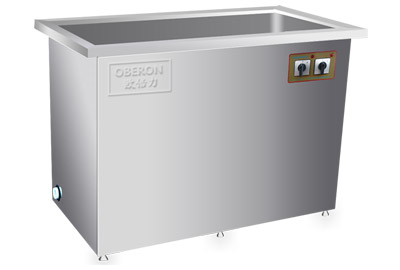
    The Oberon ST Series is an automated ultrasonic cleaning tank built for decarbonizing and degreasing kitchen equipment — pans, roasting trays, hood filters, baking molds, and smallwares. With a capacity of 1,500 to 4,500 plates per hour equivalent and just 2–3 kW of power, it soaks off carbon that would otherwise take hours of hand scraping. Load it, close the lid, and the cycle runs unattended while staff do other work.

    2. An integrated ultrasonic pre-wash

    For kitchens that want the benefit inside the main line, the Oberon SonicFlow is a hood-type dishwasher with an ultrasonic pre-wash tank built in. Dishes pass through cavitation before the main wash, arriving at the spray section with soil already lifted. The result is 70 racks per hour at just 2.2 liters of water per rack — deep cleaning without a separate soaking station.

    Oberon SonicFlow hood type dishwasher with ultrasonic pre-wash tank

    Where ultrasonic dishwashing pays off fastest

    • Bakeries and pastry shops: caramelized sugar and dough films that survive spray jets release in an ultrasonic tank, and non-stick tray coatings stay intact.
    • Central kitchens: GN pans and cookware with baked-on residue stop blocking the main dishwasher line.
    • Hotels and banqueting: equipment decarbonizing that used to happen overnight with caustic soak happens in a supervised cycle.
    • Any kitchen fighting rewash queues: pre-wash cavitation means items do not come back a second time.

    What ultrasonic does not replace

    An ultrasonic stage lifts soil; it does not sanitize. A commercial dishwasher still needs its hot final rinse or chemical sanitizing step after the ultrasonic wash, and heavily greased loads still benefit from pre-scraping. Think of ultrasonics as the deep-cleaning stage that makes every other stage faster and cheaper — not a standalone replacement for the dish line.

    What to check before buying

    • Tank size vs your worst item: the item must fit fully submerged, with clearance for cavitation to reach all faces.
    • Automation: automated lift, filtration, and cycle control decide whether the tank saves labor or just adds a tub to watch.
    • Power and utilities: ultrasonic transducers are efficient — the ST Series runs on 2–3 kW — but confirm heating power and water treatment separately.
    • Construction: full stainless tank, welded transducer mounting, and accessible service points, same as any commercial dishwasher.

    Frequently asked questions

    Does ultrasonic cleaning damage non-stick coatings or delicate items?

    No. Cavitation is gentler than scrubbing or high-pressure jets, which is why it is used on non-stick baking sheets, decorated wares, and precision kitchen equipment.

    How fast is an ultrasonic commercial dishwasher?

    The Oberon ST Series ultrasonic tank handles 1,500–4,500 plates per hour equivalent in unattended cycles, and the SonicFlow hood type machine with built-in ultrasonic pre-wash runs 70 racks per hour through the full line.

    Can I add ultrasonic pre-wash to my existing dishwasher?

    An integrated pre-wash requires the machine to be engineered for it, like the SonicFlow. As a retrofit, a standalone ultrasonic tank placed ahead of the existing dishwasher achieves the same deep-clean result.

    Does ultrasonic cleaning use a lot of water and power?

    No. The transducers themselves draw little power (2–3 kW on the ST Series), and because the tank water does the cleaning, water consumption stays low compared with repeated rewash cycles.

    Related reading

    Want to see whether ultrasonics fit your dishroom? Tell Oberon your item mix and peak volumes — we will recommend the right ultrasonic configuration, from a standalone ST tank to a fully integrated SonicFlow line.

  • How Much Does a Commercial Dishwasher Cost in 2027?

    How Much Does a Commercial Dishwasher Cost in 2027?

    Ask ten kitchen owners what a commercial dishwasher costs and you will get ten different numbers — because the honest answer depends on machine type, capacity, utilities, and how much labor it replaces. This 2027 guide breaks down what commercial dishwashers cost in the United States, then shows how installation, utilities, and maintenance reshape the total over the life of the machine. A dish machine that looks affordable up front can be expensive to own; the reverse is also true.

    Commercial dishwasher price by machine type

    The fastest way to budget is by machine family. Each type solves a different volume problem, and price follows throughput:

    • Undercounter dishwashers: roughly $3,000–$8,000. These compact units slide under a prep counter and suit bars, cafes, and satellite kitchens washing up to about 30 racks per hour.
    • Door-type (hood) dishwashers: roughly $5,000–$15,000. The workhorse for full-service restaurants and hotels, washing 40–60 racks per hour with faster cycles than undercounter models.
    • Conveyor dishwashers: roughly $15,000–$50,000. Racks move continuously through wash and rinse zones for busy institutions and high-volume restaurants.
    • Flight type dishwashers: roughly $30,000–$100,000 and up. Continuous belt systems for central kitchens, universities, and catering operations where thousands of trays and plates return every meal.

    Specialized machines — utensil washers, pan washers, crate washing systems, and ultrasonic pre-wash tanks — price between these bands depending on chamber size and automation. Treat these ranges as planning figures: final quotes move with chamber height, automation level, and utility configuration.

    What moves the price up or down

    Three factors explain most of the spread between quotes:

    • Throughput. Racks per hour drives chamber size, tank capacity, and heating power — the biggest single cost driver.
    • Materials. Full stainless steel tubs and welded manifolds cost more than painted or partial-steel builds, but they resist corrosion from detergents and heat.
    • Automation. Automatic loading, trash extraction, and heat recovery add upfront cost and remove recurring labor.

    Installation costs to budget for

    The quote rarely covers everything needed to turn the machine on. Budget separately for:

    • Utilities: three-phase power or steam supply, water treatment for hard water, and adequate drainage elevation.
    • Ventilation: a condensate hood over hood type and conveyor machines to manage steam.
    • Trade labor: plumber and electrician hours, plus dishwasher tables and dishtoating if the dishroom is new.

    Installation for an undercounter unit can be a few hundred dollars; a conveyor or flight type line with new utilities can run well into five figures. Ask suppliers to itemize what is included before comparing quotes.

    Utility and running costs: where the real money goes

    Over a five-year life, water, energy, detergent, rinse aid, and labor usually exceed the purchase price. This is where machine specs translate directly into money:

    • Water use per rack. Efficient machines use under one gallon per rack; thirsty legacy units can use three times that. At hundreds of racks a day, the difference pays for a lot of machine.
    • Tank heating. Heat recovery systems reuse exhaust warmth to pre-heat incoming water, cutting energy draw on every cycle.
    • Detergent and rinse aid. Precise dosing pumps prevent overuse; high-temp final rinse needs 180°F water, which low-temp chemical-sanitizing machines avoid at the cost of chemical spend.
    • Labor. The largest line item of all. Machines that reduce pre-scraping and rack handling can pay the difference between two and three dish staff.

    Performance numbers that predict long-term value

    Compare candidates on racks per hour (can it survive your busiest 90 minutes?), wash tank capacity (bigger tanks recover temperature faster between racks), and verified water and energy figures per rack. ENERGY STAR–listed commercial dishwashers publish these numbers, which makes side-by-side comparison honest. Detergent and rinse aid consumption per rack should be part of the same conversation.

    Advanced features worth paying for

    Heat recovery, automatic soil removal, and load-sensing wash programs raise the sticker price and lower the monthly bill. In high-volume kitchens they typically pay back within a few years; in low-volume sites the payback is slower. Stainless steel construction falls into the same category: a stronger build costs more today but resists corrosion and replacement over a longer service life.

    Calculate payback before you sign

    A simple way to compare two machines: add purchase price + installation, then estimate annual running costs (utilities + detergent + labor + maintenance). The cheaper machine to own is often the one with the higher quote. Budget for replacement too — well-maintained stainless machines commonly run 10–15 years, so spreading cost across that horizon changes the math.

    Conclusion: buy for total cost, not sticker price

    How much a commercial dishwasher costs in 2027 depends less on the machine and more on the kitchen around it. Define your peak rack volume and item mix first, then choose the smallest machine that handles that peak with efficient utilities. The right purchase balances price, durability, and running cost — and pays you back every service.

    Planning a purchase this year? Send Oberon your peak volumes and dishroom layout for a quotation modeled on real operating conditions, not a catalog guess. For more buying guidance, read our commercial dishwasher buying guide and sizing guide.

    FAQ

    What are the main cost categories for a commercial dishwasher?

    Purchase price, installation, utilities, detergent and rinse aid, maintenance, and labor. Total cost of ownership matters more than the sticker price — the cheapest machine is not always the least expensive over five years.

    Which machine type fits a small restaurant?

    An undercounter dishwasher handles roughly 30 racks per hour and fits under a standard counter. If service peaks exceed that, a door-type (hood) machine is the next step up.

    How do racks per hour and tank capacity affect cost?

    They determine whether the machine survives peak service without rewash queues. Larger tanks and faster cycles raise price but reduce labor and stabilize sanitation during rushes.

    Are energy-efficient dishwashers worth the higher price?

    Usually yes in high-volume kitchens. Heat recovery and efficient water use raise upfront cost by a modest amount and reduce utility bills every cycle; calculating the payback period with your rack volume makes the trade-off concrete.

    Why does stainless steel construction matter for value?

    Stainless tubs and manifolds resist corrosion from hot detergent solutions, extending service life and protecting resale value. The stainless steel payback period improves as replacement risk drops.

  • Commercial Dishwasher Installation Requirements

    Commercial Dishwasher Installation Requirements

    Commercial dishwasher installation requirements include water supply, drainage, electrical power, ventilation, layout, loading flow, commissioning, and maintenance access, and early coordination helps avoid expensive dishroom modifications later.

    Water supply and drainage

    Confirm incoming water pressure, water temperature, pipe size, filtration, softening needs, and shutoff access before installation, because hard water can deposit scale in tanks, nozzles, heating elements, and rinse systems. Drainage must handle peak discharge without backing up into the dishroom, and floor slope, trap position, grease management, and cleanout access should all be verified before equipment arrives.

    Electrical power and ventilation

    Commercial dishwasher electrical requirements can be substantial, because pumps, tank heaters, rinse boosters, conveyors, dryers, and controls all contribute to load. Final power needs depend on voltage, phase, heating method, model, site rules, and local code, while high-temperature, conveyor, and flight-type systems can also introduce heat and moisture that must be balanced through ventilation, exhaust, and heat recovery.

    Layout, access, and commissioning

    Plan a clear dirty-to-clean flow: sorting, scraping, pre-wash, loading, washing, unloading, drying, inspection, and storage. Staff should not move clean ware back through dirty zones. After installation, verify water fill, heat recovery, detergent dosing, rinse pressure, temperatures, leaks, safety switches, emergency stops, and real test loads before full operation begins.

    Core specifications at a glance

    Search flow moves from keyword review to SERP review and then to a medium demand estimate that reflects the observed competitor landscape.

    Intent: installation planning / project readiness.

    Utilities: water, drainage, power, ventilation.

    Workflow: dirty-to-clean flow and service access.

    Frequently asked questions

    What utilities does a commercial dishwasher need?

    Most commercial dishwashers need water, drainage, electrical power, detergent connections, and sometimes ventilation or exhaust. Exact requirements depend on the model and project layout.

    Does a commercial dishwasher need ventilation?

    Many high-temperature, conveyor, and flight-type dishwashers need ventilation planning because they release heat and moisture. Heat recovery options can reduce exhaust load in some projects.

    How much clearance should be left around the machine?

    Clearance should allow loading, unloading, door opening, filter removal, panel access, pump service, and safe technician movement. Use the manufacturer layout drawing for final dimensions.

    Can Oberon help plan installation before purchase?

    Yes. Oberon can review floor plans, utilities, workflow, and item dimensions before recommending equipment and installation requirements.

    Related reading

  • Industrial vs Commercial Dishwasher

    Industrial vs Commercial Dishwasher

    Industrial vs Commercial Dishwasher Guide

    Choosing between an industrial dishwasher and a commercial dishwasher is a question of load, flow, and risk. A small café, full-service restaurant, hotel, canteen, bakery, or central kitchen may all need professional warewashing, but they rarely need the same machine. This dishwasher comparison breaks down dishwasher types and the main buying factors so your team can choose with more confidence.

    What is the real difference between an industrial dishwasher and a commercial dishwasher?

    A commercial dishwasher is a pro-grade warewashing machine made for business use. An industrial dishwasher usually means a tougher system built for very high volume, nonstop use, odd items, or hard production settings. In daily talk, the terms overlap. That is why buyers get mixed up. The better question is not the label. It is whether the dishwasher can keep up with peak times, fit the room, wash your wares, and support the clean process your operation needs.

    Think of commercial as the broad group and industrial as the high-end part of that group. A restaurant dishwasher in a neighborhood dining room may need fast rack turnarounds at lunch and dinner. An industrial dishwasher in a central kitchen, food plant, or large institution may need longer run time, more automation, stronger soil handling, and a layout built for constant flow.

    The main dishwasher types found in pro kitchens

    Before comparing industrial and commercial equipment, it helps to know the common dishwasher types. Each one solves a different dishroom problem. The wrong one can cause backup even if the machine is solid.

    Undercounter and front-loading machines

    Undercounter machines are often used in bars, cafés, small restaurants, tasting rooms, and support service areas. They fit tight spaces and can work well when daily ware loads are steady but not huge. A front-loading commercial dishwasher can also be a good fit when staff need a glass, cup, or plate station near service.

    The tradeoff is capacity. If staff keep waiting for cycles, stacking dirty wares in the wrong spot, or pulling items out too soon, the machine is too small for the workflow. In that case, a small footprint becomes a hidden cost.

    Door-type and pass-through machines

    Door-type machines are common in busy restaurants, schools, churches, catering kitchens, and smaller institutional sites. They let racks move from a soiled side to a clean side. That makes the dishroom more orderly than a simple load-and-unload setup. For many buyers, this is the practical middle ground between a compact kitchen dishwasher and a larger conveyor system.

    This format works best when the dish table layout is planned around the machine. Staff need room to scrape, pre-rinse where needed, load racks, unload clean wares, and air dry. Without that flow, even a good machine can feel slow.

    Conveyor, rack conveyor, and flight-type systems

    Conveyor systems are built for higher-volume foodservice operations where racks move through the wash process nonstop. Flight-type machines take that idea further by moving wares through the system without standard racks for every item. These machines are often what buyers picture when they hear industrial dishwasher.

    The gain is throughput. But the choice is not only about speed. A larger system affects utilities, airflow, drainage, staffing, dishroom length, and service access. It should be planned as part of the room, not squeezed in after the kitchen is done.

    Commercial dishwasher strengths in daily foodservice

    A commercial dishwasher is often the right starting point for restaurants, cafés, bars, hotel service areas, assisted living dining rooms, and other kitchens that need repeatable cleaning and sanitation all day. These machines are made for pro use, faster cycles than home machines, and steady handling of plates, glasses, utensils, trays, and select prep items.

    The biggest strength is fit. A well-sized commercial dishwasher can support service without forcing a big dishroom or major utility work. It can also help standardize warewashing, which matters when different staff rotate through the dish station.

    A commercial machine may be a strong match when:

    • Your peak rushes are busy but not all day.
    • Most items are standard plates, bowls, glasses, cups, flatware, and trays.
    • Staff can load racks in batches without a long backup.
    • The kitchen has limited space for infeed and outfeed tables.
    • The operation needs dependable pro warewashing without industrial-scale automation.

    For many restaurants, the goal is not the biggest machine. The goal is the smallest machine that can handle the peak period with room for real growth.

    Industrial dishwasher strengths in high-volume work

    An industrial dishwasher is built for operations where warewashing is part of a larger production flow. That may include central kitchens, commissaries, bakeries, hotels with banquet service, canteens, hospitals, correctional facilities, food support areas, and large restaurant groups with shared production.

    In these sites, the dishroom is not just a clean-up area. It is a throughput system. Dirty wares, utensils, trays, pans, crates, or production tools may arrive in waves or nonstop, and the equipment has to prevent backups that can slow the rest of the operation.

    Industrial systems matter most when:

    • The machine must run for long periods with little downtime.
    • The item mix includes trays, containers, utensils, or production tools beyond normal tableware.
    • Soil levels are heavier or more varied than standard dining-room returns.
    • Labor planning depends on a more automated warewashing line.
    • The facility has the space and utilities for a larger install.
    • Dishroom delays can disrupt production, service, packing, or delivery plans.

    The practical gain is resilience. When the machine, room, and staffing plan line up, an industrial dishwasher can turn warewashing from a stress point into a controlled process.

    How should you make a dishwasher comparison for your kitchen?

    Start by comparing the work the dishwasher must do, not the names of the types. A useful dishwasher comparison looks at peak volume, item type, soil level, space, utilities, labor flow, and cleaning goals together. If one of those is missed, the final choice may look good on paper but fail during service.

    Use this list before you request a quote or set a spec:

    1. Map your busiest return period. Count when dirty wares arrive, not just how many meals you serve in a day. A lunch rush, banquet break, or production changeover can define the real need.
    2. List every item going through the machine. Plates and glasses are different from sheet pans, mixing bowls, trays, racks, crates, or utensils with baked-on residue.
    3. Separate average demand from peak demand. A machine that handles the daily average may still fail when the whole dining room turns at once.
    4. Review the dishroom path. Soiled wares need a clear route into the wash area, and clean wares need room to drain, dry, and return to storage.
    5. Check utility readiness early. Water, drainage, power, airflow, heat recovery, and chemical storage can all affect the final install.
    6. Plan service access. Equipment that is hard to clean, inspect, or maintain is harder to keep reliable.

    This approach keeps the talk tied to work. It also helps suppliers recommend a commercial dishwasher or industrial dishwasher based on use, not guesswork.

    The hidden costs of choosing the wrong size

    Undersizing creates clear problems: dirty wares pile up, staff rush, clean items run short, and the dish area gets stressful. It can also create less visible issues, such as extra handling, more breakage risk, poor drying space, and more overtime during cleanup.

    Oversizing has its own problems. A machine that is too large may take more space than needed, make utility work harder, and make the dishroom harder to staff well. Bigger equipment can be the right call, but only when the workload justifies the footprint and support needs.

    The best fit usually sits between those extremes. It gives the team enough capacity for peak demand, enough room for safe handling, and enough simplicity for daily use.

    Matching the machine to your operation

    A small restaurant may need a door-type commercial dishwasher, while a high-volume canteen may need a conveyor line. A bar may care most about glass handling and quick turnaround near the counter. A bakery may care more about bowls, trays, and utensils with heavier soil. A hotel may need different warewashing zones for restaurants, banquets, and room service.

    That is why the phrase kitchen dishwasher can mean very different things by site. In a home, it means convenience. In a pro kitchen, it affects labor, sanitation, guest care, storage, and the pace of service.

    When evaluating options, describe the job in plain work terms. For example:

    • Recover fast after a 90-minute dinner rush.
    • Wash trays and prep containers all afternoon.
    • Current rack flow creates a backup at the clean side.
    • Growing from one service line to multiple outlets.
    • Need a system that can support catering and daily dining.

    These statements help more than just saying you need the best dishwasher. They point to capacity, layout, and setup.

    Oberon Warewasher’s practical role in the decision

    Oberon Warewasher focuses on professional warewashing equipment for foodservice and facility sites where reliability, layout, and daily use matter. For buyers comparing a restaurant dishwasher, commercial dishwasher, or industrial dishwasher, the best talk starts with the real dish flow.

    If you are gathering resources for your team, save this Oberon guide: https://oberonwarewasher.com/blog/industrial-vs-commercial-dishwasher/. Use it as a starting point for internal planning before you talk about sizing, install, and model choice.

    A smarter choice starts with the dishroom

    The gap between industrial and commercial dishwashing is not just machine size. It is the link between volume, item mix, labor, space, utilities, and the cost of falling behind. Once you understand those pressures, the right category is much easier to spot.

    For most foodservice operations, a well-fit commercial dishwasher gives the best mix of speed and footprint. For high-volume or special-use sites, an industrial dishwasher may be the better long-term fit. Either way, the best choice starts with a clear look at how your kitchen really works on its busiest day.

    Related reading